By Katie Deuel, Chief Program Officer
We set off early, dressed for a hot, half-day drive along Brazil Highway 262. The busy road passes through the tropical savanna of the Cerrado biome and into a corner of the Pantanal biome, the world’s largest freshwater wetland, which spans parts of Brazil, Bolivia, and Paraguay.
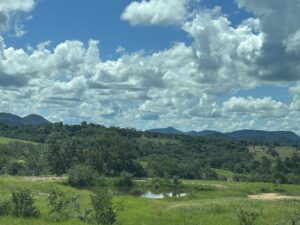
Known worldwide as an ecotourism destination for its rich biodiversity, the Pantanal biome (a biome is a landscape-scale region delineated by its unique ecology, including climate, plants and animals), is home to many of Brazil’s quirky—to this northerner—and elegant, iconic species such as the feathery tailed, gentle-looking giant anteater, the stub-nosed, water-loving capybara (the world’s largest rodent!), and the tapir, a three toed ungulate with an elongated snout that is most closely related to the rhinoceros.
However, wildlife habitat in and around this vast, tropical landscape is gradually shrinking as land is cleared for production of some of the country’s biggest imports such as beef and soybeans.
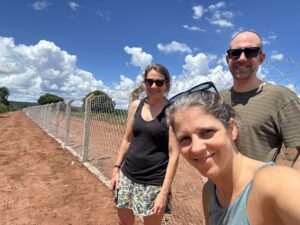
And wildlife movement is increasingly hampered by highways.
Our CLLC team of three had recently arrived at Campo Grande, Brazil, from our distant homes in mountain towns of Montana and the beach town of Florianopolis, Brazil, in advance of the Convention on Migratory Species’ COP-15. This international gathering of leaders aimed to address urgent conservation challenges facing migratory species, and this was our side trip to see some of these challenges first-hand.
“I expected to get out of the car a few times to look at wildlife crossing structures with their new fencing and maybe a road-killed animal or two. But what we actually saw was deeply disturbing: an unfolding pantheon of animals that I had only dreamed of glimpsing in the wild in my lifetime, but laid out on the road, killed by vehicles.”
Our team consisted of Fernanda Teixeira, Linear Infrastructure Program Advisor; Aaron Laur, International Connectivity Program, Policy and Partnerships Manager; and myself, Chief Program Officer. We arrived well into our own mental journeys of understanding the deep challenges of, and increasing opportunities to address, the impacts to wildlife of linear transport infrastructure like roads, railways, canals and powerlines. We were especially eager to experience the Pantanal and surrounding area, location of a multi-year project we have engaged in to identify and conserve jaguar movement corridors, and to travel on Brazil Highway 262 through a corner of the biome.
The “Highway of Death”
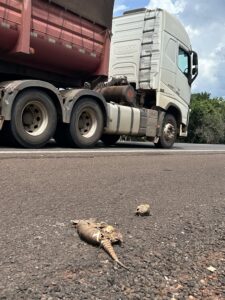
Brazil 262 is known as the “highway of death” for its high rates of wildlife mortality caused by vehicle strikes. In just one year, 2,263 animal carcasses were recorded on this stretch of road. Several factors converge to create this deadly effect. The road runs through a biodiversity hotspot filled with species that aren’t adapted to running from predators, such as the anteaters that sit down when threatened, ready to attack with the long sharp digging claws instead of fleeing. This particular highway is a heavily used transport route for large ore trucks from active regional mines that are unlikely to brake for wildlife. During our journey we saw many, many of these trucks traveling at high speeds on 262.
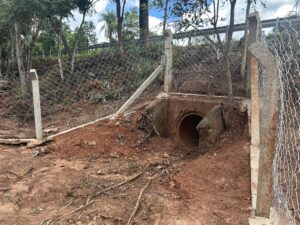
To address this deadly combination, conservationists have been working for years with Brazil’s government to put in place effective signage for motorists and fencing and underpasses designed for wildlife. We came to look at how the implementation of these mitigation measures was progressing and if it was helping.
I expected to get out of the car a few times to look at wildlife crossing structures with their new fencing and maybe a road-killed animal or two. But what we actually saw was deeply disturbing: an unfolding pantheon of animals that I had only dreamed of glimpsing in the wild in my lifetime, but laid out on the road, killed by vehicles.
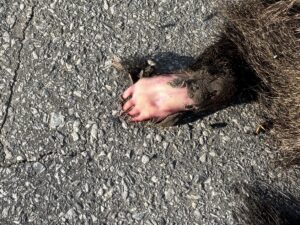
I confess that I have rarely taken the time to pull over and examine roadkill, though I do occasionally keep a running tally of the animals I see as I travel high-speed highways notorious for wildlife-vehicle collisions in my home state of Montana. What I learned on that narrow, 60 mph speed limit road in the humid heat of Brazil’s western Cerrado/Eastern Pantanal region was this: there is something extraordinarily intimate—infused with wonder, both satisfying and horrifying to my intense curiosity, and deeply, deeply sad about examining a dead animal that has been killed by human intrusion to its native home.
Standing over the animals was, for me, a moment out of time, as I considered exquisite ears, odd-shaped mouths, noses, feet, hooves, claws, and hides evolved so perfectly for exactly the role they play in their home ecosystems. But these ecosystems they had originally adapted for did not include roads.
For the record, and because we were all keeping a tally that day on Highway 262, we observed: five armadillos (there are several kinds), three capybaras, two crab-eating foxes, two giant anteaters, two southern tamandua (arboreal anteaters), an alligator, and a South American tapir. It took us all day, cost us sunburns and heartache and dehydration, but we could not go any faster and still both truly experience what was happening and honor the animals laid out along the road.
Signs of Hope
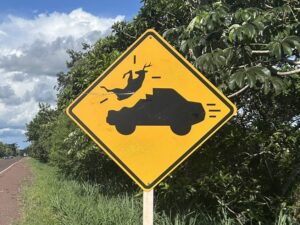
On balance, we did also observe progress towards de-fragmenting the landscape through mitigation measures prompted by years of research, advocacy, and cooperation across entities. Roadside fences are going up, there are new underpasses in place, and we found a new sign designed to both capture drivers’ attention and encourage them to slow down. While there were many existing signs with written warnings, this new sign was tested with citizens and is thought to be more attention-grabbing and effective in reducing speed (see photo, above).
I am a scientist and a conservationist, a mother, and a consumer of food and energy, a citizen of planet Earth. I am not new to the grief of seeing an area that was once wildlife habitat become a place of danger riddled with barriers to movement. I have spent my life recognizing and working to reverse the impacts of the human footprint on the natural world that ultimately sustains us all.
I am proud to work at CLLC, with colleagues like Fernanda and Aaron, where we strive to ensure that these animals in Brazil and species all over the world can live safely in their natural environments, that they have room and safe passages to move in the face of climate change, habitat impacts, and fragmentation. Much of our work happens off the roads—analyzing habitat and wildlife movement data, creating the conditions that drive conservation, working with communities to find solutions, and consulting with those designing crossings—but it is important to also see first-hand the impacts of human infrastructure. Sadly, Highway 262 is not unique. The same problems are occurring all over the world and it is essential that solutions are scaled up for widespread implementation.
One of the many ways we are doing this is by through our leadership in the Latin American and Caribbean Transport Working Group, Asian Elephant Transport Working Group, and the IUCN WCPA Connectivity Conservation Specialist Group, as well as providing consultation to governments—such as Costa Rica—on how to make wildlife-friendly roads and other linear infrastructure the norm. CLLC is committed, with the help of partners and supporters, to preserving habitat connectivity and safe passage for wildlife in landscapes throughout the world.
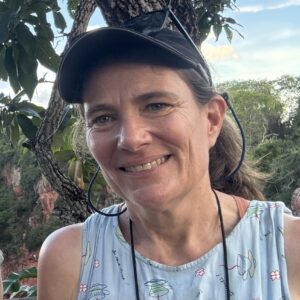
Katie Deuel is the Chief Program Officer at the Center for Large Landscape Conservation. She works across our diverse programs to ensure they are strategic, effective, inclusive, connected and supported. She has been a leader in biodiversity and large landscape conservation, nature-based education, and building sustainable, circular economies, as well as working extensively as a facilitator and mediator in complex systems. At the center of her work is a passion for systems thinking, cold water, and empowering people. She lives with her family in Missoula and enjoys time outside in most any form.
All photos by CLLC