Advancing wildlife crossings along US-191 and MT-64 to reduce collisions and keep habitat connected
Yellowstone National Park’s 2.2 million acres provide critical habitat for the largest concentration of wildlife in the lower 48 states. But this habitat doesn’t stop at the park borders.
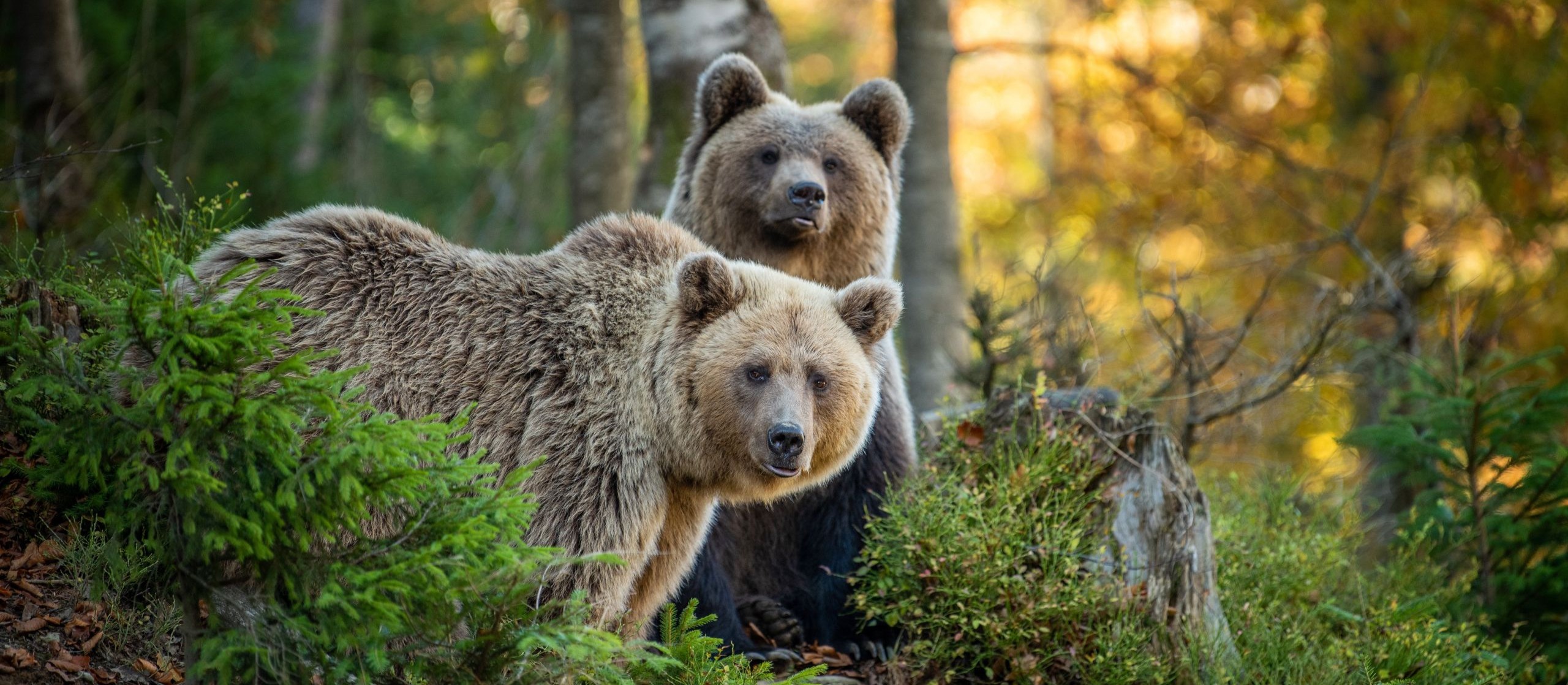
Herds of elk, deer and pronghorn move in and out of Yellowstone to access seasonal ranges, and predators like wolves and grizzly bears travel great distances. These species, along with bighorn sheep, wolverines, and others, move throughout the Greater Yellowstone Ecosystem—a richly biodiverse area composed of a patchwork of public and private lands.
However, directly northwest of the park, in Montana, this region is increasingly affected by growing traffic on roads and new subdivisions. As the area’s economy has expanded, so has the number of wildlife-vehicle collisions.
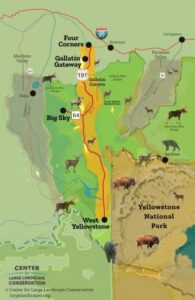
The US-191/MT-64 Wildlife Crossings Project addresses this challenge by a) improving knowledge of wildlife movement and road safety along roads that connect Yellowstone National Park to the growing Montana population centers of Bozeman and Big Sky, and b) working with communities, businesses, individuals and agencies to implement wildlife crossings to fix the problem for current and future generations of people and iconic species.
View a 2-page description of the project.
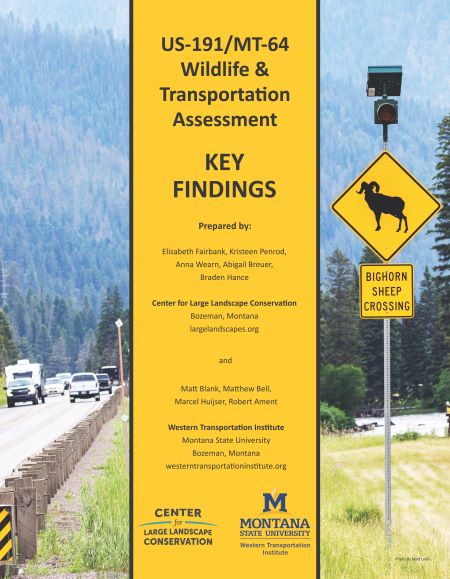
Our activities are based upon an in-depth US-191/MT-64 Wildlife & Transportation Assessment that identified 11 priority sites. View the Assessment report (164 pages) or read its Key Findings (12 pages).
The US-191/MT-64 Wildlife & Transportation Assessment was carried out jointly by the Center for Large Landscape Conservation and Montana State University’s Western Transportation Institute.
Winter 2025-26: Two New Billboards on US-191!
Traveling on US-191 this winter between Bozeman and Big Sky? Be sure to look for two new billboards south of Gallatin Gateway—a hotspot for collisions, especially with elk—urging drivers to watch for wildlife on the road.
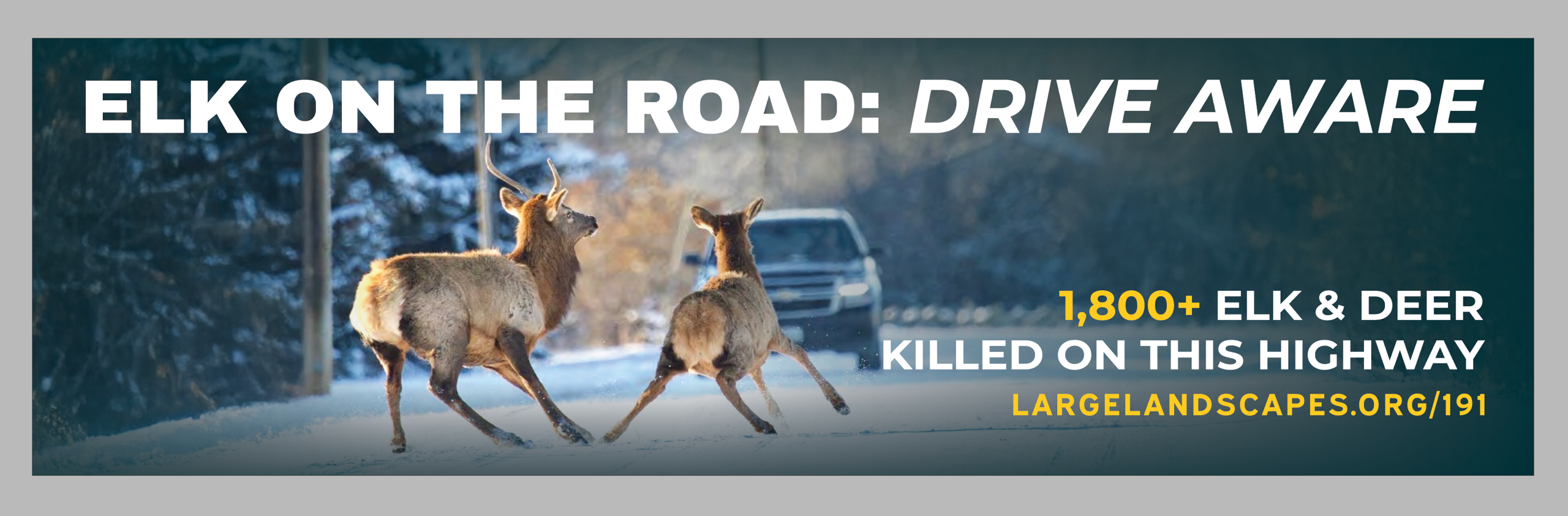
Many thanks to the generous individuals and organizations who contributed to this billboard project: Courtney Collins of Courtney Collins Fine Art in Big Sky, and Jim Winjum, owner of Bozeman-based Kenetrek Boots, donated their billboard space to make this safety messaging possible. The billboards feature an image from Holly Pippel, a Gallatin Gateway photographer and wildlife advocate, as well as design by Outlaw Partners.
Did You Know?
- 24% of all collisions along US-191 through Gallatin Canyon (Four Corners to Big Sky) are with wildlife. This is more than double the state average (10%) and five times the national average (5%)!
- More than 1,800 elk and deer were killed on US-191, from Four Corners to West Yellowstone, from 2012 to 2020.
- About 80% of Big Sky workers commute via US-191 and MT-64. Traffic volume on US-191 (Four Corners to Big Sky) rivals several sections of I-90 in Montana.
- Wildlife-vehicle collisions are a threat to 21 federally listed endangered and threatened species.
- Properly sited and designed wildlife crossing structures with fencing commonly reduce wildlife-vehicle collisions by 85% or more.
Read more in our Wildlife Crossings FAQs

Wildlife Crossings: Where We Are Now
Application-ready
Wildlife crossings at the “mouth of the canyon” (Gallatin Gateway to Spanish Creek priority area)
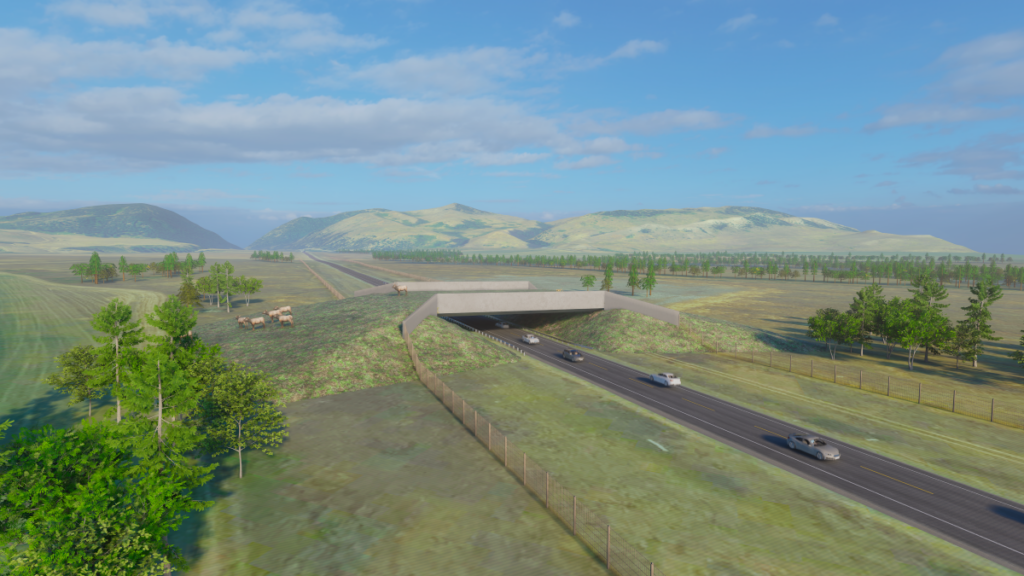
The Montana Department of Transportation and the Center are awaiting information about federal grant programs, such as the Wildlife Crossings Pilot Program, able to support an application for: a wildlife overpass (see rendering), enlargement of an existing stockpass, and “retrofit” of the large bridge at the mouth of Gallatin Canyon with a path offering secure footing for elk and other ungulates. Located within the top priority site identified in the US-191/MT-64 Wildlife & Transportation Assessment, these structures would be linked by fencing in order to reduce wildlife-vehicle collisions by 80-97%.
The Center has been able to move crossings to “application ready” status based on years of work in the making supported by area communities and project approval by the statewide Montana Wildlife and Transportation Partnership.
The image below is a conceptual rendering of a wildlife overpass south of Gallatin Gateway. The structure’s final design, location, dimensions, and aesthetic attributes would be determined by the Montana Department of Transportation in a pre-construction design phase.
Project Funding
To unlock federal funds to cover over 80% of project costs, about 20% must be secured by private or other, non-federal funding. Thanks to the bold and inspiring generosity of community organizations, business leaders, and individuals, the Center has made significant strides toward securing the necessary non-federal match for crossings near Gallatin Gateway. We are grateful to these generous donors (scroll down for the list of project supporters from start to finish).
Project Timeline
A wildlife crossing, like any infrastructure project, is a complex process that rarely takes fewer than 5 years from concept to construction. However, crossings are legacy projects that remain on the ground for an average of 75 years and often pay for themselves in cost savings from reduced wildlife-vehicle collisions well in advance of the end of their lifespan.
Engineering Feasibility
In 2024, supported by community partners, the Center hired Jacobs, a global engineering leader, to examine wildlife overpasses, underpasses, bridge retrofits, and associated accommodations—including fencing to funnel wildlife to suitable structures—in two priority areas. Projects in both areas were determined to be feasible. This marks another major step forward.
Read about the engineering feasibility study and what goes into the siting and design of a wildlife crossing.
Other Priority Sites
At Spanish Creek (road marker 68.1) and Teepee Creek (road marker 11), we have proposed suitable structures to mitigate the impact of the road on wildlife moving across these important drainages during ongoing planning for upgrades in these areas. Safe passage for wildlife can be achieved by replacing aging infrastructure with wildlife-friendly options. We continue to advocate for consideration of wildlife movement along each of the US-191/MT-64 Wildlife & Transportation Assessment’s priority sites and other road projects along US-191.
How to Help
Share your interest in wildlife crossings with the Montana Department of Transportation (MDT)! With passing lanes and other infrastructure improvements along US-191 in key planning stages, your voice is important to elevate attention to safe wildlife passage. Submit your comments to MDT
More Information
Read our three-part series of articles in Explore Big Sky newspaper:
Wildlife-vehicle collisions have become common as Gallatin Valley grows
Obstacle course: When a road hinders wildlife movement
Crossing to safety: New possibilities for U.S. Highway 191
Now is the time to ensure wildlife can use use habitat freely as our region’s population and tourism continue to expand.
 Let’s Keep in Touch!
Would you like occasional email updates on the US-191/MT-64 Wildlife Crossings Project and progress toward reducing wildlife-vehicle collisions?
If so, please sign up here! You can unsubscribe at any time.
With Sincere Thanks
We would like to acknowledge the generosity of the following supporters of the US-191/MT-64 Wildlife & Transportation Assessment and the US-191 Wildlife Crossings Project Fund, including matching pledges for an application for federal funding:
Big Sky Real Estate Collective
Big Sky Resort Area District
Cinnabar Foundation
Cromley Messina Foundation
Gallatin Wildlife Association
Greater Yellowstone Coalition
Hey Bear
Langlas & Associates
Christopher Li
Lohss Construction
Lone Mountain Land Company
J. Love Legacy Foundation
Patrick Mitchell
Moonlight Community Foundation
Outlaw Partners
Overland West
Andrew Sabin Family Foundation
Schlauch Bottcher Construction, Inc.
SITKA Gear
TMC, Inc.
Turner Family
Turner Foundation
The Volgenau Foundation
Weeden Foundation
Yellowstone Club Community Foundation
Questions about the Center’s activities along US-191? Please contact us at 191@largelandscapes.org
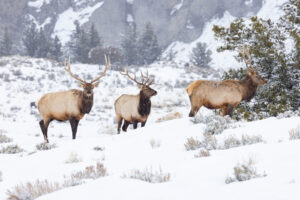
Banner Photo: The Gallatin River and US-191 near Big Sky, Montana – Adobe Stock; Elk photo: NPS/Jacob W. Frank